
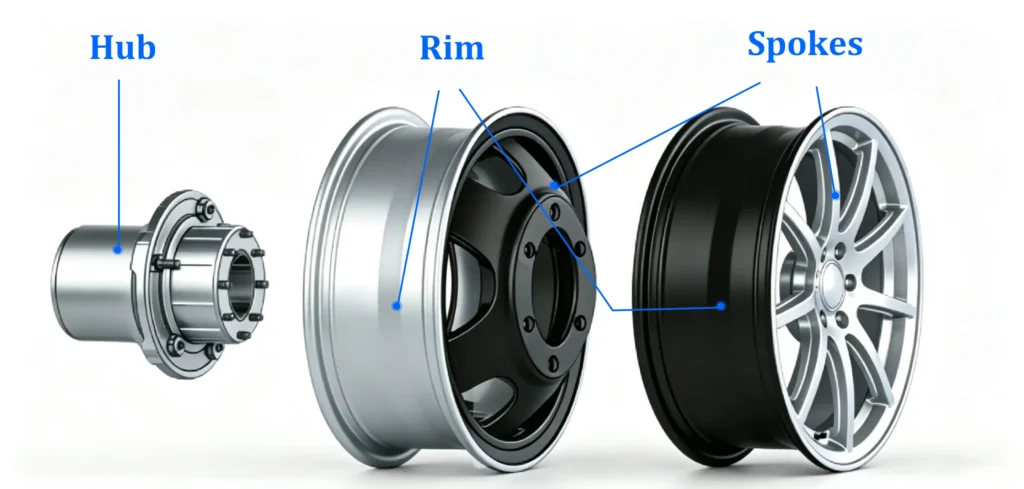
Car wheel parts look simple from the outside, but together they form an assembly where each component has a specific job. The rim seats and seals the tire, the spokes carry loads, the center bore centers everything on the hub, and the bolt pattern clamps it all in place. This guide walks through the parts of a car wheel and explains what each one does, working from the outside in.
The car wheel parts diagram below shows where each component sits.
Wheel vs Rim: Two Different Things
In everyday conversation, “rim” and “wheel” are used interchangeably, but they are not the same thing. The wheel is the entire round metal assembly that bolts to your car. The rim is only the outer edge of that assembly, the part where the tire bead seats. The parts of a car rim include the lips, the barrel, the bead seats, the drop center, and the flanges. On a spec sheet, the two words mean different parts, and knowing the difference helps when you order replacement car wheel parts or talk to a shop.
The Rim: The Outer Ring
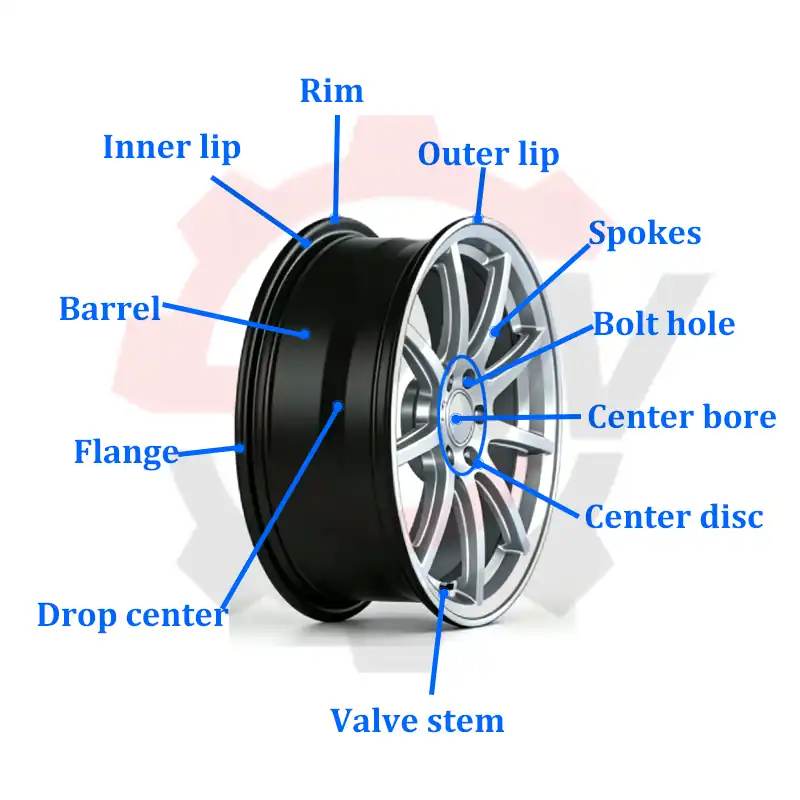
The rim forms the outer perimeter of the wheel and is built from several distinct parts.
Outer Lip and Inner Lip
Most wheels have an outer lip, the side you can see, and an inner lip, the side facing the suspension. Both lips help contain the tire bead and maintain the shape of the mounting area. A wheel can look fine on the outside yet be bent on the inside lip, which is why vibration problems often need a close inspection.
Barrel
Between the two lips runs the barrel, the cylindrical body that gives the wheel its width. The barrel forms the inner cavity behind the spokes, and brake components sit inside this space, so barrel shape and diameter influence brake clearance.
Bead Seats
On the inside of the barrel are the bead seats, the ledges where the tire’s beads rest. When you inflate the tire, air pressure pushes the beads outward and upward into these seats, creating an airtight seal. A clean, undamaged bead seat is critical for holding pressure. Corrosion, pitting, or gouges on the bead seat cause slow leaks, so if you keep topping off air, the wheel itself may be the problem, not the tire.
Drop Center
The narrowest part of the barrel is the drop center, a recessed channel that lets a technician slip the tire on and off during mounting without overstretching the bead wires. The drop center also helps keep the tire attached to the wheel if pressure drops.
Flanges and Bead Humps
The edges of the barrel flare outward into flanges, which keep the tire from slipping off. Just inside the flanges, many wheels include small raised ridges called bead humps or mounting humps. They hold the beads in place during cornering or if the tire loses pressure.
The Spokes and the Face
The spokes are the arms that connect the center of the wheel to the rim. Together they form the face, the styled side you see. Spokes are structural and cosmetic at the same time: their number, thickness, and bracing affect rigidity, weight, and how the wheel handles impacts.
Five-spoke designs are common for an engineering reason. Each spoke is supported by two opposing spokes, which reduces torsional vibration. That said, spoke count has less effect on weight and performance than the materials and construction methods used.
The Center Disc
The center disc is the area where the spokes meet the hub mounting surface. This section carries the heaviest loads because it transfers forces between the hub and the rim. If a wheel fails, cracks usually start in the stressed regions near the center disc or the spoke junctions. That is one reason to take wheel damage seriously after a hard impact: a wheel can look mostly fine yet carry a hidden crack that worsens over time.
The Center Bore (Hub Bore)
The center bore is the large hole in the middle of the wheel that slides over the vehicle’s hub. On factory wheels, this hole is machined to match the hub diameter exactly, a setup called hub-centric mounting. The precise fit centers the wheel and carries part of the vehicle’s weight, which is why a hub-centric wheel usually rides smoother than one centered by the lug nuts alone.
If the center bore is larger than the hub, which is common on universal aftermarket wheels, centering rings take up the slack so the wheel still sits correctly.
Bolt Holes, Lug Seats, and Mounting Pad
Bolt Holes and Bolt Pattern
The bolt holes are the circle of openings that lug nuts or bolts pass through. The bolt pattern is defined by the number of holes and the diameter of the circle they form, written as something like 5×114.3, meaning five holes on a 114.3 mm circle. A wheel must match the vehicle’s bolt pattern exactly to mount safely.
Lug Seats
Each bolt hole has a lug seat, the area where the lug nut or bolt makes contact. Seats are usually conical or ball-shaped, and the seat shape must match the hardware. Mismatched lug seats cause looseness, vibration, and uneven clamping force. Over time, they can damage the wheel or the studs.
Mounting Pad and Offset
Behind the bolt holes is the mounting pad, the flat surface that presses against the hub. This surface determines the wheel’s offset, how far the wheel sits inward or outward relative to the hub centerline. Offset affects clearance, stance, steering feel, and suspension geometry.
The Hub Side: Hub, Bearings, and Fasteners
The Hub
The wheel hub sits at the center of the assembly. The wheel mounts on it, and the hub assembly keeps the wheel attached to the vehicle while allowing it to spin freely. The hub also plays a role in the anti-lock braking system and traction control.
Wheel Bearings
Inside the hub are the wheel bearings, which let the wheel spin with minimal friction. A bearing has three basic parts: an inner race, rolling elements, and an outer race. Bearings must be matched to the vehicle’s load type and maximum speed.
Wheel Studs and Lug Nuts
The wheel is fastened by wheel studs, threaded fasteners pressed into the hub, and lug nuts that clamp the wheel against the mounting pad. The lug nuts must be tightened evenly so the wheel clamps down flat against the mounting pad.
Valve Stem and TPMS
The valve stem is where you add air. On most vehicles built after 2007, the stem also houses a TPMS sensor that reports tire pressure to the dashboard. The sensor is a serviceable part and can be transferred or replaced independently of the wheel.
Center Cap
The center cap covers the middle of the wheel. It is mostly cosmetic, but it also protects the spindle nut and wheel bearings from dirt, and it usually carries the brand logo. A missing cap does not change how the wheel performs.
Wheel Specs That Matter
When you shop for car wheel parts, five specifications determine fitment.
Diameter is the wheel size across the bead seat, such as 16 or 20 inches, and it must match the tire size. Larger wheels typically need lower-profile tires to keep the overall diameter close to factory specs.
Width is the distance between the inner bead seats, not from outer lip to outer lip. It determines which tire sizes fit correctly.
Bolt pattern must match the vehicle exactly, with no room for approximation.
Offset, usually a number in millimeters like +35, controls how far the wheel sits inward or outward. The right offset keeps clearance correct and steering feel stable.
Load rating describes how much weight the wheel can safely support. It should meet or exceed the vehicle’s requirements, especially if you carry passengers or gear regularly.
OEM vs Aftermarket Wheels
OEM wheels are engineered for one specific platform, so the center bore, offset, and load rating all line up without adapters or spacers. Aftermarket car wheel parts are built to fit a broad range of cars, so they often use a larger center bore plus plastic centering rings to take up the slack.
For most drivers replacing a damaged wheel, an OEM replacement is the simpler path: the bolt pattern, offset, and finish already match the other three wheels, so there is no guesswork about fitment.
Frequently Asked Questions
Is a rim the same as a wheel?
No. The wheel is the entire assembly that bolts to the car; the rim is only its outer edge, where the tire bead seats.
Why does my tire keep losing air even though there is no puncture?
Often the bead seat. Corrosion or gouges on the bead seat break the airtight seal and cause slow leaks, so the wheel, not the tire, may be the problem.
What does a bolt pattern like 5×114.3 mean?
Five bolt holes on a circle 114.3 millimeters in diameter. The wheel must match this pattern exactly to mount safely.
Can I fit aftermarket wheels on my car?
Yes. Universal aftermarket wheels use a larger center bore plus centering rings to fit many cars, while OEM wheels are machined for one specific platform.
Does a missing center cap matter?
Not for performance. The cap is cosmetic but protects the spindle nut and bearings from dirt, so replace it eventually.