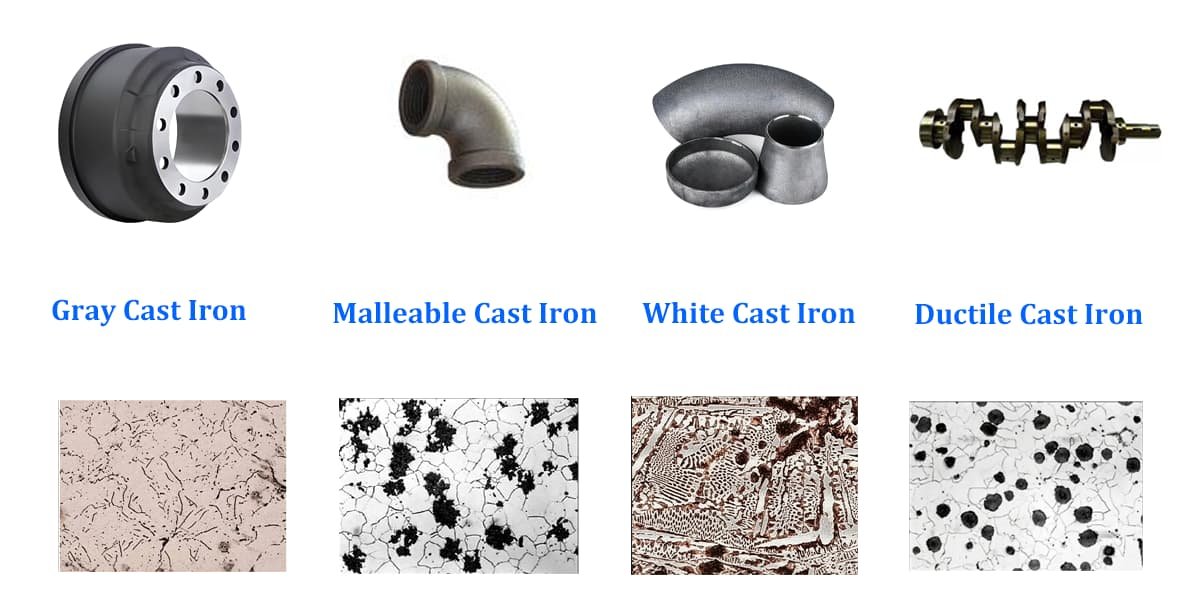
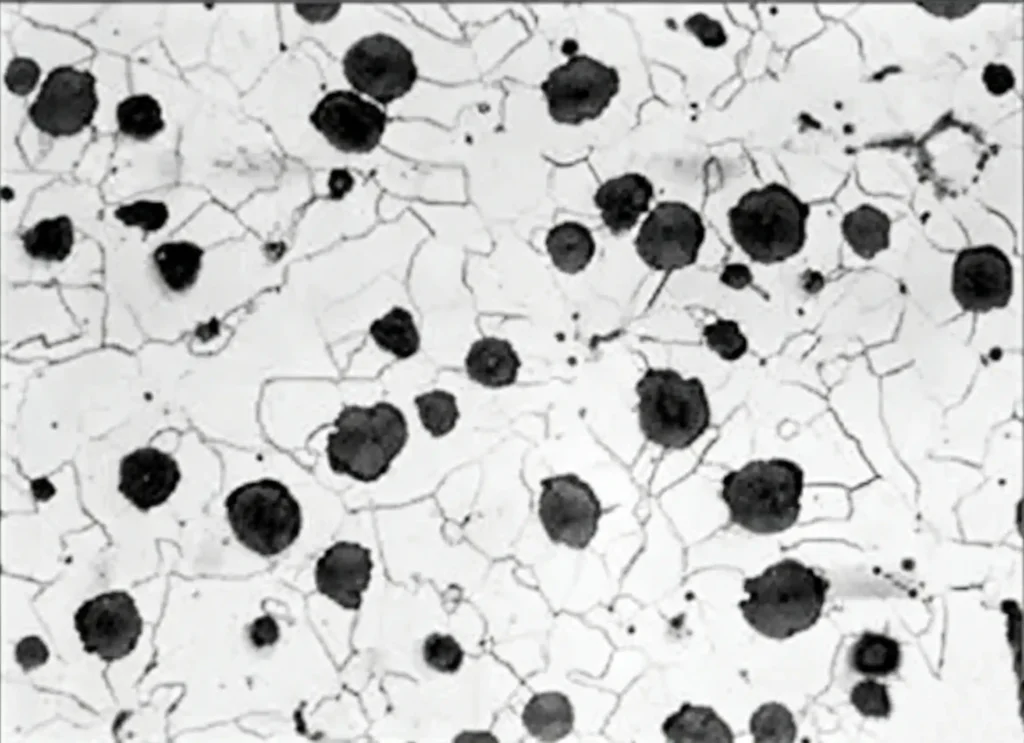
Ductile iron is a group of graphite-rich cast irons in which the graphite takes the form of spherical nodules instead of flakes. That single microstructural difference gives the material far higher impact and fatigue resistance than that of ordinary cast iron, together with measurable elongation. The material is also known as ductile cast iron, nodular cast iron, spheroidal iron, and SG iron.
This guide explains what makes ductile iron different, how it is produced, the main types, its mechanical properties, and its most common applications.
Ductile Iron vs Cast Iron: What Makes Ductile Iron Different from Other Cast Irons?
To understand ductile iron, start with the weakness of ordinary cast iron. In gray iron, carbon separates out of the melt during solidification as thin, sharp graphite flakes. Those flakes act like internal notches. Under load, stress concentrates at their sharp edges, cracks start easily, and then spread through the part. That is why gray iron is weak in tension and brittle under impact.
Ductile iron contains the same basic elements, but its graphite forms as rounded spheres, called nodules. Because they have no sharp edges, the nodules do not concentrate stress the way flakes do. Cracks cannot start or propagate easily, so the surrounding metal matrix stays continuous and the material can bend, absorb impact, and endure repeated loading rather than fracture.
The practical difference is large. A gray iron part dropped a short distance can crack on impact. A ductile iron part of the same size can survive the same drop, and even repeated hammer blows, without cracking. In numbers, the tensile strength of gray cast iron runs roughly 20,000–60,000 psi, while ductile iron ranges from about 60,000 to 120,000 psi.
Ductile iron also keeps the advantages that make gray iron popular in machinery. The graphite itself acts as a dry lubricant, which reduces wear on moving surfaces. The material also dampens vibration, dissipates heat effectively, and is relatively easy to machine.
Ductile cast iron
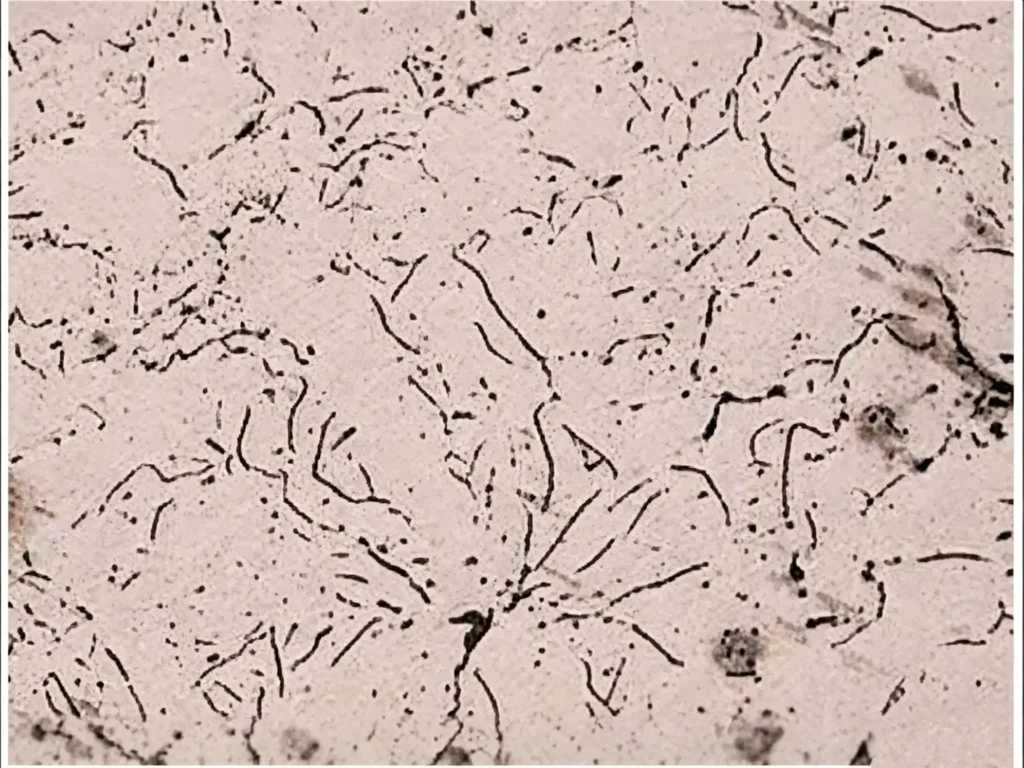
Gray cast iron
Ductile iron Casting Process:How Is Ductile Iron Made?
The nodular graphite does not form by accident. It is produced by adding nodulizing elements to the molten iron before casting. The most common is magnesium, a notable choice because it boils at 1100 °C while iron melts around 1500 °C. The addition therefore has to be carefully controlled. Cerium, usually added in the form of mischmetal (a mixture of rare earth elements), is also used, and tellurium has been used as well.
Carbon is present in excess, in amounts greater than the iron matrix can absorb into solution. As the iron cools, the surplus carbon, together with silicon, manganese, sulfur, and oxygen in the melt, separates out as graphite, and the nodulizing elements force that graphite into spherical nodules. Standard casting processes are then used to shape the part.
A typical ferritic ductile iron contains roughly 3.0–3.7% carbon and 1.2–2.8% silicon, with a small residual amount of magnesium (about 0.03–0.07%) and low sulfur and phosphorus levels. Alloying additions tune the result further: adding copper or tin increases tensile and yield strength while reducing ductility, and replacing 15–30% of the iron with nickel, copper, or chromium improves corrosion resistance.
What Are the Main Types of Ductile Iron?
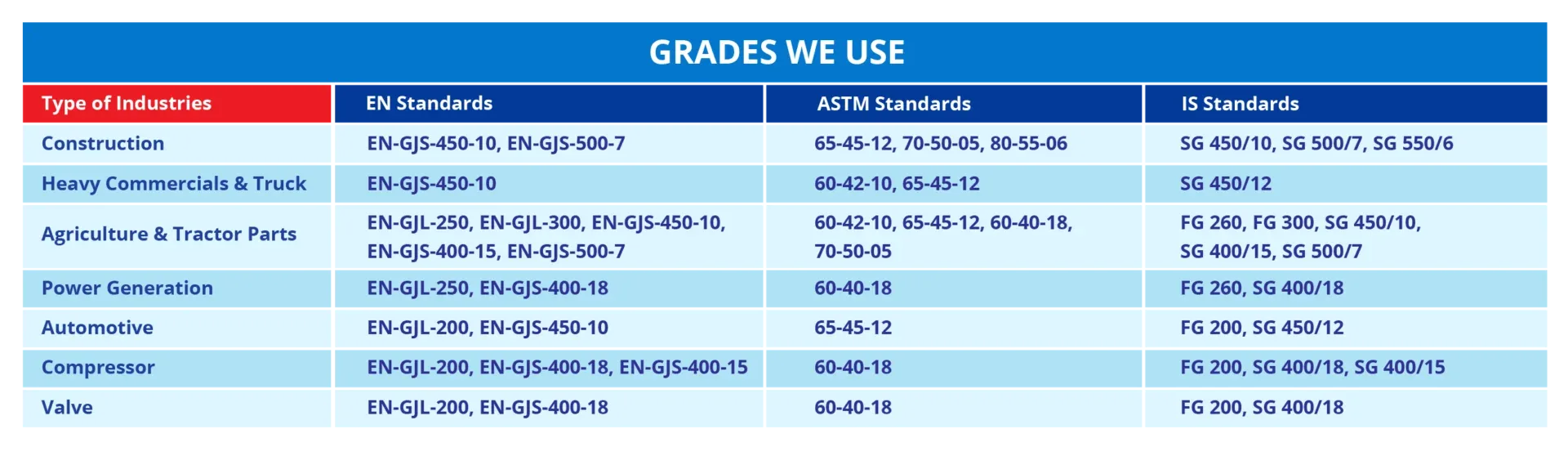
Ductile iron is not a single material. By controlling the metal matrix that surrounds the graphite nodules, producers create a family of grades with very different properties. The following are the seven main types.
| Type | Matrix | Key Characteristics |
|---|---|---|
| Ferritic | Ferrite | Tensile and yield strength comparable to low-carbon steel |
| Ferritic-pearlitic | Ferrite + pearlite | Properties between ferritic and pearlitic grades; easy to machine and inexpensive to produce |
| Pearlitic | Pearlite | High strength, impact resistance, moderate ductility, good wear resistance and machinability |
| Martensitic | Martensite | Made by quench-and-temper heat treatment that prevents pearlite formation; high strength but lower ductility and toughness |
| Bainitic | Bainite | Very durable and wear-resistant |
| Austenitic | Austenite | Dimensional stability at higher temperatures, strength, magnetic characteristics, excellent corrosion resistance |
| Austempered (ADI) | Austempered structure | Produced by a heat treatment called austempering; delivers nearly double the performance of pearlitic ductile iron, with excellent strength, wear resistance, and fatigue strength |
ADI (austempered ductile iron) deserves special mention. It is the most recently developed grade in the family, and its structure is created through austempering, a specialized heat treatment.
Ductile Iron Properties:What Are the Mechanical Properties of Ductile Iron?
Because the family spans many grades, properties are best shown as ranges:
| Property | Ductile Iron |
|---|---|
| Tensile strength | 414–1380 MPa |
| Yield strength | 275–620 MPa |
| Elongation | 18–35% |
| Brinell hardness | 143–187 |
| Charpy impact strength (unnotched) | 81.5–156 J |
| Density | 7100 kg/m³ |
| Melting point | 1149 °C |
The ferritic grades alone already match the tensile and yield strength of low-carbon steel, and typical minimum specified values are 448 MPa tensile strength and 310 MPa yield strength.
Ductile Iron Applications:What Is Ductile Iron Used For?
Ductile iron’s combination of strength, toughness, and castability puts it to work across many industries.
Pipe and pipe fittings. This is the largest single use. More than half of all ductile iron production goes into pipes and fittings for transporting fluids, especially water and sewer lines. Plastic pipes such as PVC and HDPE are lighter, but they are softer and weaker and need protection from physical damage.
Automotive components. Ductile iron is used where strength must surpass that of aluminum but expensive steel is not required: crankshafts, connecting rods, steering knuckles, disc brake calipers, wheel hubs, and suspension parts.
Machinery and heavy equipment. Gearboxes and gears, pump housings, manifolds, high-pressure valves, oil well pumps, agricultural tractors, and class 8 trucks all rely on the material’s fatigue strength and vibration damping.
Wind power. Hubs and structural parts such as machine frames, all large, complex shapes that must carry high fatigue loads.
Other applications. Piano harps (the iron plates that anchor the strings), vises, and military components.