
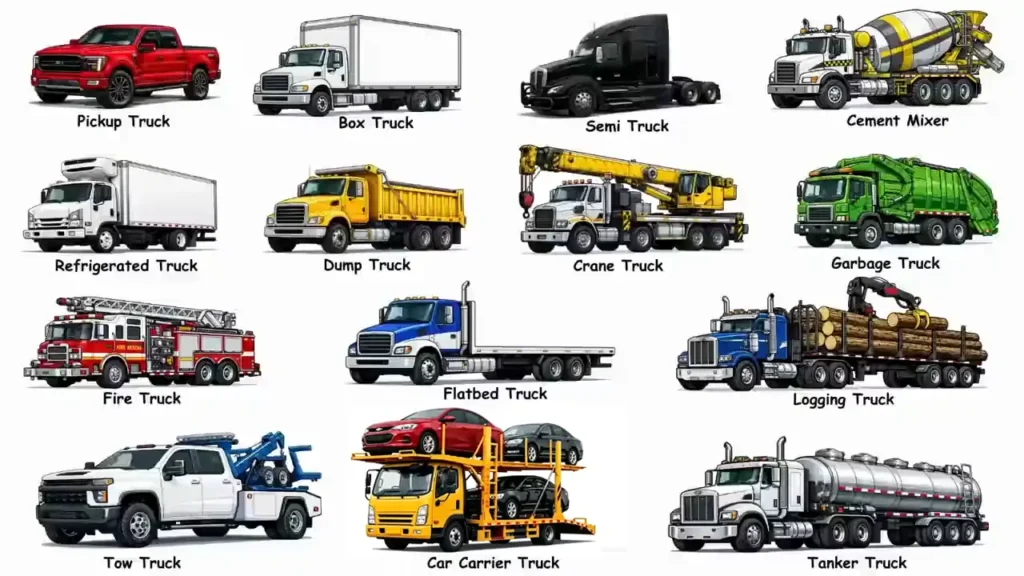
Trucks are grouped in two ways. The official truck classification system sorts them by weight, using a rating called GVWR. The everyday system sorts them by body shape and the job the truck does. This guide explains the weight classes, the different types of trucks on the road, and the rules that decide who can drive them.
Different Types of Trucks:Why Are Trucks Classified by Weight?
Think of weight classes like clothing sizes. A truck’s “size label” is its gross vehicle weight rating, or GVWR. The GVWR is the maximum weight a vehicle can safely handle when fully loaded. That total includes the truck itself, plus passengers, fuel, and cargo.
You can find the number on a safety label in the driver’s side doorjamb.
The rating matters because it decides which rules apply to the truck. The GVWR affects how the vehicle is registered, whether it must stop at weigh stations, and what kind of license the driver needs. Once you know a truck’s class, you know most of the rules that govern it, the same way a clothing size tells you which rack to check.
What Are the Truck Weight Classes?
In the United States, trucks are divided into eight main classes. Each class covers a range of GVWR values.
| Class | GVWR (lbs) | Category | Typical examples |
|---|---|---|---|
| 1 | Up to 6,000 | Light-duty | Compact pickups, utility vehicles |
| 2 | 6,001–10,000 | Light-duty | Full-size pickups |
| 3 | 10,001–14,000 | Light-duty | Heavy-duty pickups with increased towing capacity |
| 4 | 14,001–16,000 | Medium-duty | Box trucks, walk-in trucks, city delivery trucks |
| 5 | 16,001–19,500 | Medium-duty | Bucket trucks, larger delivery trucks |
| 6 | 19,501–26,000 | Medium-duty | School buses, beverage trucks |
| 7 | 26,001–33,000 | Heavy-duty | City transit buses, garbage trucks, street sweepers |
| 8 | 33,001 and up | Heavy-duty | Big rigs, dump trucks, cement trucks |
Light-duty trucks (Classes 1–3) cover the vehicles you see every day: SUVs, minivans, and pickup trucks. They handle small loads, landscaping work, and light towing.
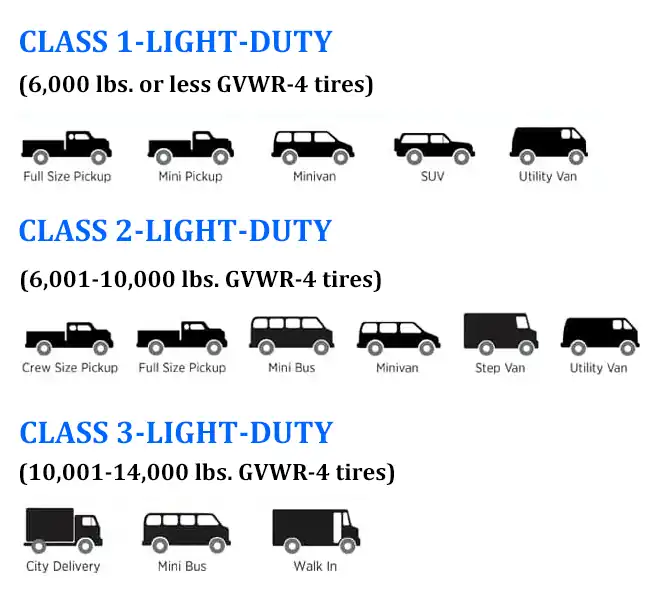
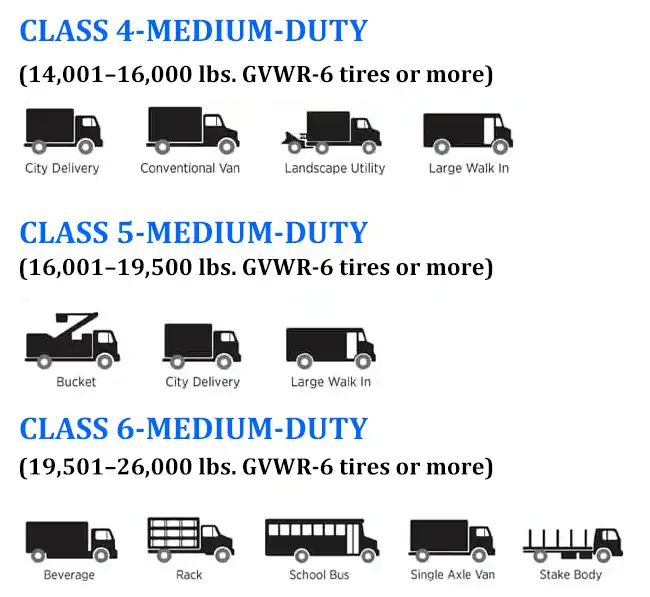
Medium-duty trucks (Classes 4–6) are mostly commercial vehicles. This is where you find box trucks, city delivery trucks, bucket trucks, and school buses. The need for a commercial driver’s license often starts at Class 6.
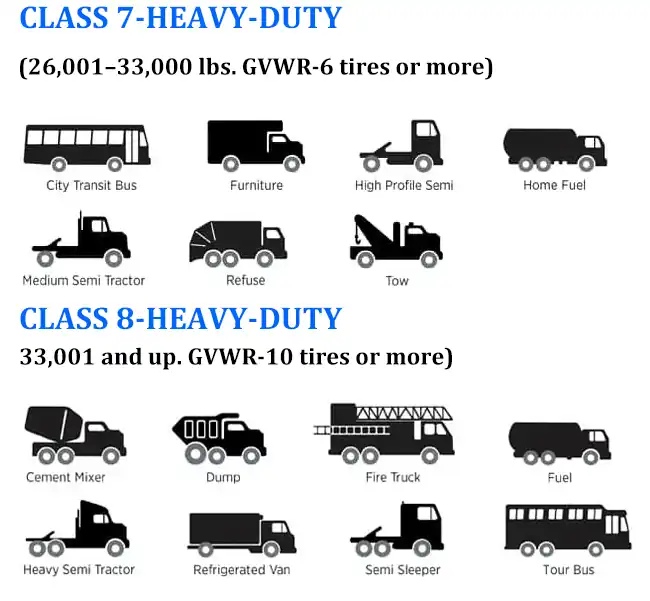
Heavy-duty trucks (Classes 7–8) are the big commercial machines: garbage trucks, transit buses, dump trucks, cement trucks, and the big rigs built by manufacturers like Peterbilt and Freightliner. Class 8 is sometimes called “severe duty” instead of heavy duty. Above Class 8, a few super-heavy trucks fall into a special Class 9, with limits set case by case using the Federal Bridge Gross Weight formula.
Each size fits a different job: a small pickup for light errands, a big rig for cross-country freight.
What Are the Most Common Types of Trucks on the Road?
Weight classes are the official language. Most people identify trucks the other way: by shape and by job. That works because every truck is built like a tool. Its shape follows the task it was made for. Look at the body, and you can usually guess the cargo.
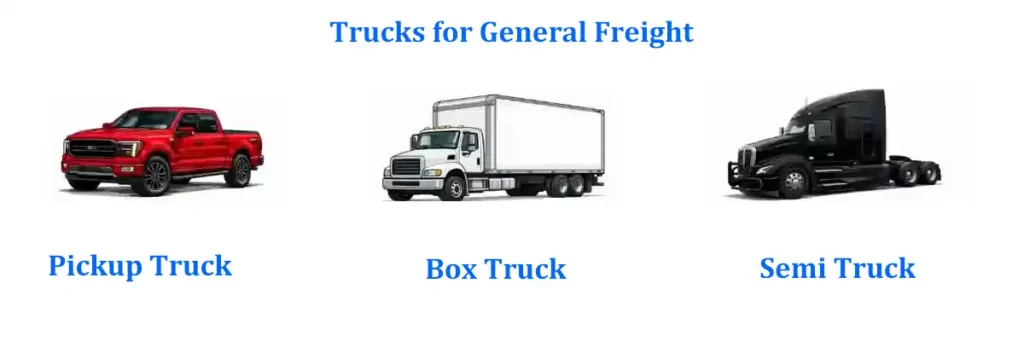
Trucks for General Freight
Pickup truck. An enclosed cab with an open cargo bed behind it, low sides, and a tailgate. Pickups are the most popular trucks on the road, used for everything from daily driving to light hauling.
Box truck. A cab with an enclosed, box-shaped cargo area mounted on the chassis, usually with a roll-up rear door. Box trucks move furniture, appliances, and household goods, and typically run 10 to 26 feet long.
Semi-truck. A tractor unit pulling a semi-trailer, attached by a fifth-wheel coupling, a hitch that lets much of the trailer’s weight rest on the tractor. Known as “big rigs” or “eighteen-wheelers,” semis carry freight over long distances. The cab is either a day cab for short trips or a sleeper with a bunk for overnight routes.
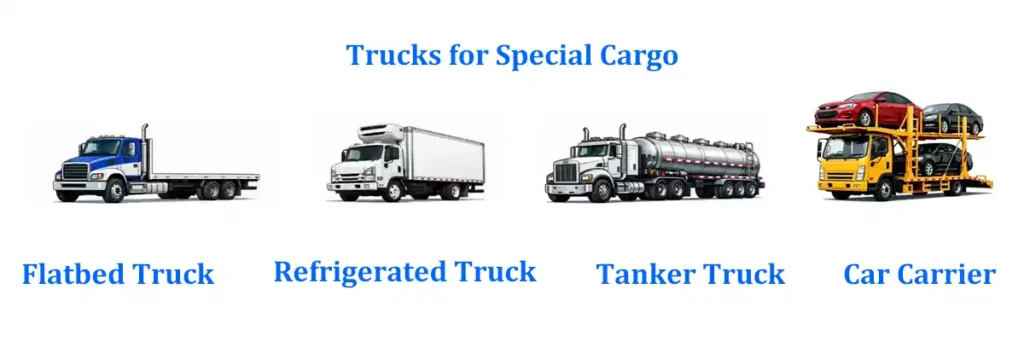
Trucks for Special Cargo
Flatbed truck. A flat, open bed with no sides or roof. Flatbeds carry heavy loads that can stand exposure to weather, as well as oversized freight that needs more space than an enclosed body can offer, such as steel beams, machinery, and construction materials.
Refrigerated truck. Commonly called a “reefer,” this truck carries perishable goods at controlled temperatures. The refrigeration unit has its own power source, so the cargo stays cold even when the tractor is disconnected.
Tanker truck. A sealed tank on wheels, built for liquids and gases: fuel, water, milk, or industrial chemicals. Many tanks are insulated or pressurized depending on the load.
Car carrier. An open double-deck or enclosed trailer with built-in ramps, used to move vehicles from manufacturers to dealerships.
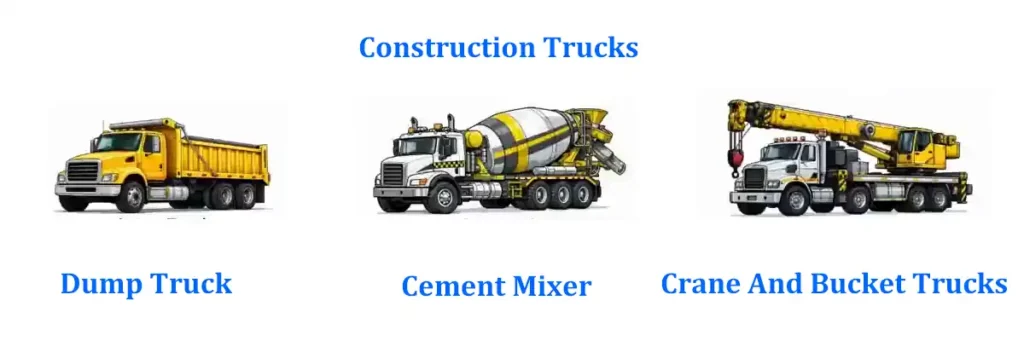
Construction Trucks
Dump truck. An open bed hinged at the rear. Hydraulic rams tilt the bed upward, emptying sand, gravel, or demolition waste onto the ground behind the truck.
Cement mixer. A rotating drum mixes cement, water, and aggregate (sand or gravel) into concrete, or keeps already-mixed concrete at the right consistency on the way to the job site.
Crane and bucket trucks. A crane truck lifts and moves heavy materials with a hydraulic boom. A bucket truck carries workers to high, hard-to-reach spots in a bucket at the end of an extendable boom, for jobs like trimming trees or repairing power lines.
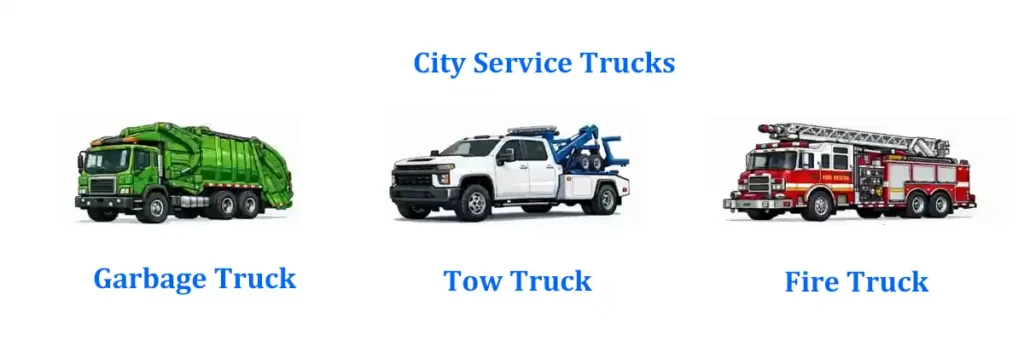
City Service Trucks
Garbage truck. Collects municipal solid waste and hauls it to a landfill or treatment facility. Many are fitted with powered arms that lift and empty waste containers.
Tow truck. Moves disabled, illegally parked, or impounded vehicles, using a boom, a wheel-lift, or a flatbed.
Fire truck. Carries hoses, ladders, sirens, and a crew to fight fires.
Recognizing trucks works the same way as recognizing tools: the shape tells you the job.
What Rules and Licenses Apply to These Trucks?
Heavier trucks demand more from their drivers, and the rules scale with size.
Commercial licenses. Drivers of the largest vehicles need a commercial driver’s license, or CDL. CDLs come in three classes: A, B, and C. Which one applies depends on the vehicle’s GVWR and on whether it is built to carry ten or more passengers, driver included.
DOT numbers. Vehicles over 10,000 pounds must carry a DOT number on both sides.
Weight limits. Federal law sets a maximum gross weight of 80,000 pounds for vehicles on the road. Anything heavier requires a special permit, and sometimes an escort vehicle.
A second truck classification system. The Federal Highway Administration also sorts vehicles into 13 categories based on axle count. That system is used for traffic monitoring and statistics rather than licensing.
Weight limits also vary by state, and the Department of Transportation publishes state-by-state resources for commercial operators.
It follows the toolbox logic: the bigger the tool, the higher the qualification needed to operate it.