
What Is GVWR?
GVWR stands for gross vehicle weight rating: the maximum loaded weight a vehicle’s manufacturer specifies for safe operation. Exceeding it overstresses the brakes, tires, and suspension, and can lead to fines, denied insurance claims, or legal liability. This guide explains what GVWR includes, how it differs from the weight ratings around it, and how to calculate payload and towing capacity from it.
What Does GVWR Mean?
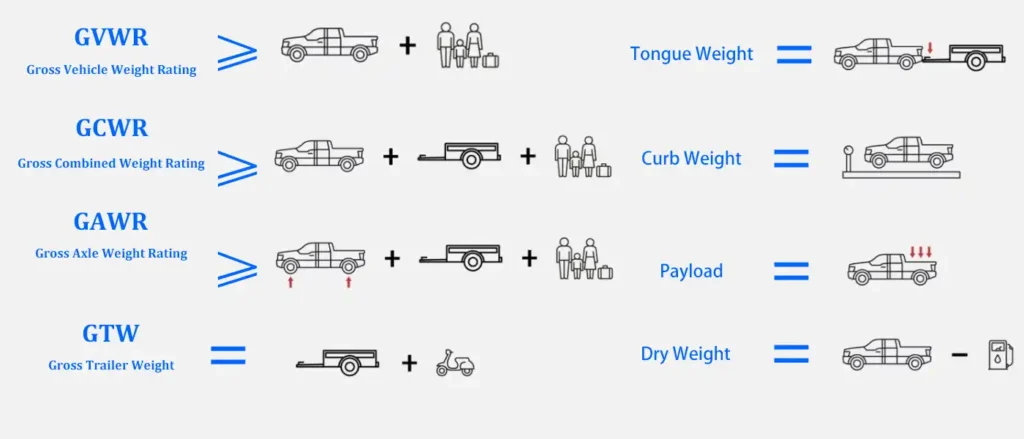
The Gross Vehicle Weight Rating is the manufacturer‑specified maximum total weight for safe vehicle operation. This rating includes the base vehicle, passengers, cargo, fuel and accessories. It does not include the weight of any towed trailer — trailer weight falls under a separate rating known as the Gross Combined Weight Rating (GCWR).
To set the number, manufacturers evaluate how much load each weight-bearing component can take: suspension, frame, axles, wheels, tires, and body. Front and rear axle ratings are based on the weakest-rated component in each assembly, and the two combined determine the GVWR.
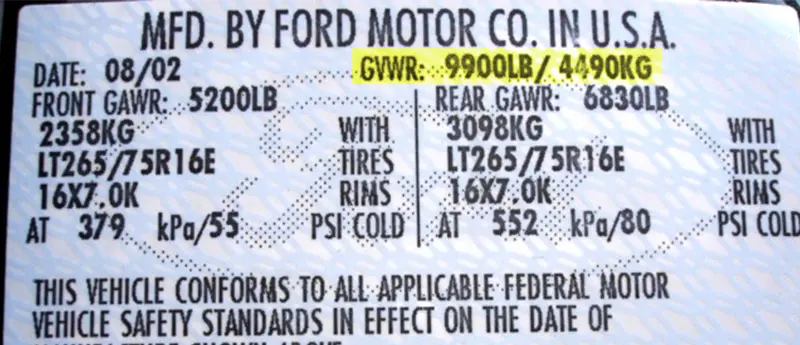
You can find a vehicle’s GVWR in three places:
- On a placard or certification label at the driver’s side door, typically on the door lock facing or the door latch post pillar
- In the owner’s manual
- On the manufacturer’s website
GVWR vs. GVW
GVWR and GVW are often confused, but they measure different things. The GVWR is a fixed rating set at the factory. It never changes, no matter what the vehicle carries. The gross vehicle weight (GVW) is the actual weight of the vehicle at a given moment, measured on a scale, including the truck, cargo, and passengers.
The rule is simple: the scale-measured GVW should never exceed the GVWR.
Five related terms come up in most weight discussions:
| Term | Meaning |
|---|---|
| GVWR | Maximum allowable weight of the fully loaded vehicle, set by the manufacturer |
| GVW | Actual scale-measured weight of the vehicle and its load at a given moment |
| GCWR / GCVWR | Maximum total weight of a fully loaded vehicle plus a fully loaded trailer |
| GAWR | Maximum weight a single axle can support, rated separately for front and rear |
| GTW | Gross trailer weight: the total weight of a loaded trailer |
The Weight Ratings That Work With GVWR
GVWR is the anchor of a small family of ratings. Each one isolates a different part of the total weight.
Curb weight covers the vehicle itself with standard factory equipment and all operating fluids, fuel included, and no passengers or cargo on board.
Payload capacity is everything added on top of curb weight: passengers, cargo, accessories, and tongue weight. It equals the GVWR minus the curb weight.
Tongue weight is the downward force a trailer exerts on the hitch ball. It is approximately 10 percent of the gross trailer weight, and it counts against the truck’s payload, not the trailer’s.
GCWR (or GCVWR) is the total weight limit for a loaded vehicle and its loaded trailer combined. Exceeding it strains the drivetrain and braking systems.
GAWR limits the weight on each individual axle. Vehicles carry separate front and rear ratings, and cargo must be distributed to respect both.
One more term appears in specifications: dry weight, the vehicle’s weight without any liquids at all, including fuel, oil, and coolant.
How to Calculate GVWR and Related Numbers
Four formulas cover most real-world weight checks.
1. GVWR = curb weight + payload capacity. The rating is the sum of the vehicle’s own weight and everything it can carry. A truck with a curb weight of 6,500 pounds and a payload capacity of 3,500 pounds carries a GVWR of 10,000 pounds.
2. Payload capacity = GVWR − curb weight. A vehicle with a GVWR of 12,000 pounds and a curb weight of 7,500 pounds offers 4,500 pounds of payload. For a concrete case: a Ford F-350 fitted with a light bar, toolbox, and spare tire scales at 6,800 pounds, and its door placard shows a GVWR of 14,000 pounds. Subtracting gives 7,200 pounds of available capacity for cargo, passengers, and tongue weight combined.
3. Remaining cargo capacity = GVWR − loaded scale weight. When the exact curb weight is unknown, drive the vehicle onto a commercial scale with passengers on board. Subtract the reading from the GVWR, and the result is the cargo capacity still available.
4. Towing capacity = GCVWR − curb weight − payload. A truck with a GCVWR of 20,000 pounds, a curb weight of 5,000 pounds, and 3,000 pounds of payload on board has a towing capacity of 12,000 pounds. Towing figures typically run well above payload figures, since the trailer’s axles, not the truck’s, carry most of that weight.
One factor is easy to miss in these calculations: tongue weight. A 5,000-pound loaded trailer presses roughly 500 pounds down onto the hitch, and that 500 pounds consumes part of the truck’s payload capacity.
GVWR and Truck Weight Classes
GVWR is the basis for the official truck weight classes, which run from Class 1 (up to 6,000 pounds) to Class 8 (33,001 pounds and above). Within the pickup segment, trucks are traditionally grouped by carrying capacity into three classes:
- Half-ton pickups are the light-duty option, suited to general driving and light jobs like hauling trash or moving furniture.
- Three-quarter-ton trucks take on the same jobs with bigger loads, and can pull light fifth-wheel trailers.
- One-ton trucks do the heaviest work: carrying large campers and heavy trailers, horse trailers included.
What Happens When You Exceed GVWR
Overloading a vehicle has consequences in four areas: mechanical, operational, legal, and financial.
Mechanical damage. Excess weight stresses the engine, transmission, brakes, tires, suspension, and frame. Components overheat and wear prematurely, tires can fail, and stopping distances grow significantly. Overloading is also a recognized contributor to rollover crashes.
Loss of control. Overloading degrades steering, maneuverability, braking, and acceleration. Judging stopping distances, holding control on downhill grades, and cornering all become harder.
Legal and financial exposure. Violations of weight limits can bring heavy fines, and vehicles may be impounded. If an overloaded vehicle is involved in a collision, insurance companies may deny the claim, and the operator can face civil suits or, in some states, criminal charges.
Higher fleet costs. For fleet operators, overloading accelerates wear, raises maintenance costs, and increases breakdowns and vehicle downtime.