
Ask someone “what’s inside your brakes?” and they’ll picture a shiny disc and a pair of clamps. That’s disc brakes. But on many cars, especially the rear wheels, that picture is wrong.
Pop open a rear wheel on an economy car, a pickup, or a bus, and you won’t find a disc. You’ll find a sealed metal can: a brake drum. It looks like a solid chunk of iron. No visible moving parts.
Inside? Seven or eight parts, working together. And the best way to understand them: an umbrella opening inside a tube.
Press the brake pedal, hydraulic pressure pushes two curved “arms” outward against the drum’s inner wall. The arms are lined with rough material that grabs the spinning metal. Friction does the rest.
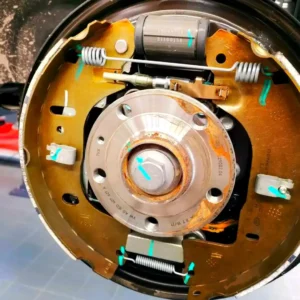
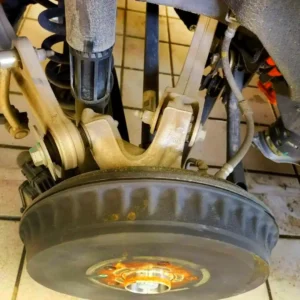
What’s the “stage” everything sits on?
The Backing Plate is a thin metal disc bolted to the axle. It’s the floor of the stage. Every other component mounts to it. It doesn’t rotate.
The Brake Drum is a heavy, bowl-shaped cast iron piece bolted to the wheel hub. It spins with the wheel. The inner surface, machined perfectly smooth, is what the brake shoes press against.
In our umbrella: drum = tube, backing plate = handle base.
What actually pushes against the drum?
Inside the drum sit two brake shoes, half-moon shaped metal pieces. These are the umbrella ribs. At rest, they sit close together, not touching the drum.
On the outer surface of each shoe is a layer of brake lining, a high-friction material (organic or semi-metallic) riveted or glued to the metal. This is the umbrella fabric. It’s the part that makes contact and creates stopping force.
The shoes push outward, expanding like an umbrella inside a tube. Linings press against the spinning drum’s inner wall, and friction converts motion into heat. That’s braking. 🔥
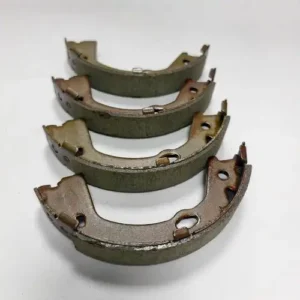
How does the system know when to brake?
The wheel cylinder sits at the top of the backing plate, between the two shoes. Inside are two pistons, one facing each shoe.
Press the brake pedal, and brake fluid rushes into the cylinder. Fluid pressure pushes both pistons outward. Pistons push the shoes. Shoes push the linings against the drum. All in a fraction of a second. ⚡
Umbrella translation: wheel cylinder = the button. Hydraulic fluid = the force through the shaft. Pistons = the mechanism pushing the ribs apart.
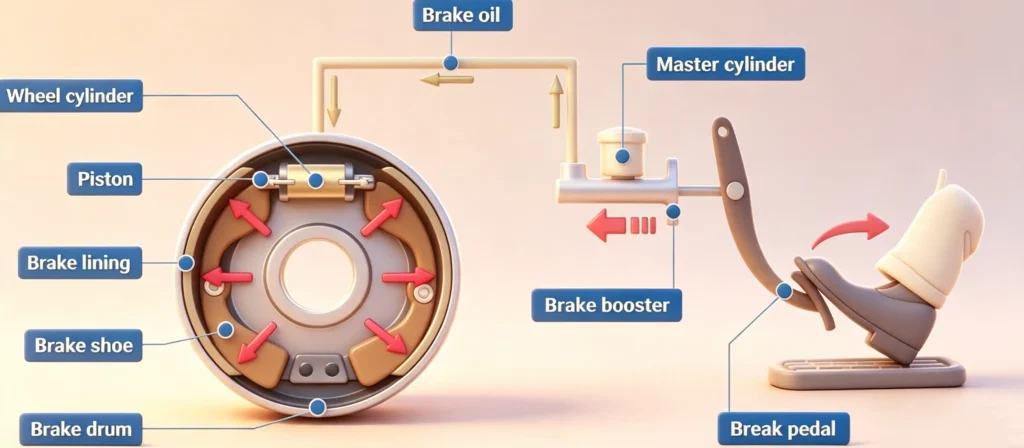
What other parts keep everything working smoothly?
Return Springs are coiled springs that pull the shoes back to rest when you release the pedal. Usually two: upper near the cylinder, lower near the adjuster. They’re the umbrella’s closing mechanism. Let go, and the ribs snap back. 💨
The Adjuster sits at the bottom between the two shoes. It looks like a small screw with a star wheel. As linings wear thinner over thousands of miles, the adjuster automatically lengthens to keep the shoes close to the drum. Without it, your pedal would sink lower and lower. Think of it as the umbrella’s tension adjuster: it keeps the fabric tight even as it stretches.
The Parking Brake Lever is a mechanical arm attached to one shoe. Pull the handbrake, a cable pulls this lever, and it physically pushes the shoes apart. No hydraulics needed. That’s why your parking brake works even if your brake lines fail. A completely separate mechanical backup. 🔧
Why are drum brakes actually stronger than they look?
Drum brakes have a trick disc brakes can’t do: the self-servo effect.
When the leading shoe (in the direction of rotation) presses against the spinning drum, friction tries to drag the shoe along with it. This dragging wedges the shoe even tighter against the drum. Extra braking force, for free. The trailing shoe doesn’t get this boost, so the leading shoe always wears faster.
Umbrella version: the tube is spinning. When you open the umbrella inside, the fabric catches the rotation and pulls one rib tighter against the wall. Free extra friction. This is why drum brakes remain popular on heavy vehicles like trucks and buses. Every bit of stopping power counts. 💪
Drum brakes haven’t gone anywhere. They’re on the rear wheels of many economy cars and pickups. They’re standard on heavy trucks, trailers, and buses. And they’re almost always used for parking brakes, even on cars with four-wheel discs. Why? They’re cheaper to make, last 50,000 to 100,000 km, and the self-servo effect gives them serious holding power. The trade-off: enclosed means slower cooling. But for rear wheels and heavy loads, that’s worth it.
Key Takeaways
- A drum brake is a system with 7-8 parts working together inside a sealed drum 🥁
- Picture it: an umbrella opening inside a tube. Shoes = ribs, linings = fabric, drum = tube, wheel cylinder = button, return springs = closing mechanism ☂️
- The wheel cylinder uses hydraulic pressure to push shoes outward; return springs pull them back when you release the pedal
- The self-servo effect gives drum brakes extra stopping power: the spinning drum helps wedge the shoes tighter, a trick disc brakes can’t do
- Drum brakes last 50,000-100,000 km and are still used on rear wheels, heavy vehicles, and parking brakes. Durable, affordable, and strong