
You’re driving when the car behind you starts honking and flashing. You’re not going slow. You’re not weaving. The problem is invisible from the driver’s seat: your brake lights aren’t working. The driver behind you almost rear-ended you. They had no warning you were stopping.
Most people assume the bulbs burned out. But there’s another culprit hiding under your dashboard: the brake light switch.
Think of it like a doorbell. Press the button, the chime rings, everyone inside knows someone’s there. The brake switch works the same way. The “button” is your brake pedal, the “chime” is the red lights on your tail. When it breaks, the signal never gets through.
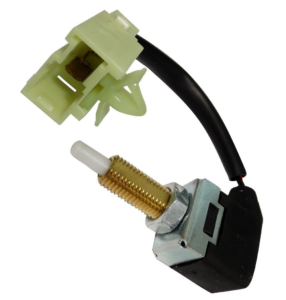
What exactly is a brake light switch?
The brake light switch is a spring-loaded electrical switch mounted behind your brake pedal, under the dashboard. It has one job: detect when you’re braking, and tell the car.
When you’re not braking, the pedal rests against the switch’s plunger, pushing it in. Circuit open, lights off. Press the pedal down, and the pedal moves away. The spring pushes the plunger out, contacts touch, circuit closes, lights on. Release the pedal, and the plunger slides back in. Lights off.
It’s a doorbell in reverse. Instead of pressing to ring, you release to light up. But the guts are the same: a spring, two metal contacts, a simple on/off signal.
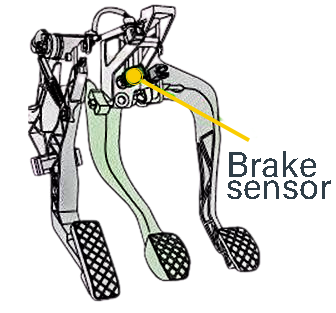
What else does it control?
If the brake switch only turned on your taillights, it would already be important. But it’s pulling triple duty.
It tells your cruise control to shut off when you brake. It tells your shift interlock that you’re braking, which is why you can’t move out of Park without stepping on the pedal. And it sends a signal to your car’s electronic control module (ECM) so the engine can adjust fuel delivery and idle speed while you slow down.
Same as the doorbell: one press, multiple people get the message.
How do you know it’s failing?
A brake switch doesn’t usually fail with a bang. It fades. And the symptoms can be confusing.
The most obvious: brake lights don’t come on. You might not notice until someone tells you, or you back up to a wall at night and see no red glow.
The reverse can happen too: brake lights stay on even after you park. This drains your battery and confuses every driver behind you.
Then there are the less obvious clues. Cruise control stops working. Your automatic transmission won’t shift out of Park. The car doesn’t “know” you’re pressing the brake. Sometimes the ABS or check engine light comes on.
All the same problem: a broken doorbell. It won’t ring, or it won’t stop ringing, or nobody got the message.
What causes it to fail, and how much to fix it?
The brake switch is mechanical. Every time you brake, the contacts inside rub together. Over years, especially in stop-and-go traffic, they wear out. Moisture, dirt, and road salt from your shoes can corrode the connectors. Sometimes the switch just slips out of its bracket. A millimeter of misalignment, and it stops working.
This is one of the cheapest car repairs out there. A replacement switch costs $30 to $75. Labor adds about $80, so you’re looking at roughly $110 to $155 total. Most mechanics finish in 10 to 30 minutes.
If you’re comfortable with basic DIY, you can do it yourself. Disconnect the battery, unplug the old switch, pop the new one in, reconnect, test. Under half an hour. Most manufacturers recommend checking it around every 50,000 miles.
Don’t put this off. Broken brake lights are illegal and dangerous. You’re invisible to the cars behind you. A $50 part is a small price for not getting rear-ended.
Key Takeaways
- The brake light switch is a spring-loaded switch behind your brake pedal. Press the pedal, the switch closes, the lights come on. Just like a doorbell.
- It controls more than brake lights: it manages cruise control, the shift interlock, and signals to the engine computer.
- Common failure signs: brake lights won’t turn on or won’t turn off, cruise control doesn’t work, can’t shift out of Park, warning lights on the dashboard.
- Replacement costs $30 to $75 for the part, plus about $80 for labor, roughly $110 to $155 total. DIY takes under 30 minutes.
- This is a safety-critical part. A broken brake switch makes your car invisible to other drivers and can leave you stranded in Park. Fix it as soon as you notice a problem.