
You can reset the Service StabiliTrak light by turning the vehicle off and restarting it, disconnecting the battery, or cycling the steering wheel from lock to lock. These methods clear the warning when it was triggered by a temporary glitch. They do not fix a mechanical or electrical fault — if the underlying problem remains, the light comes back on.
Before resetting, understand what the message means. “Service StabiliTrak” appears when the stability control system has detected a fault and has shut itself off. Resetting the light without resolving the cause only makes the warning disappear temporarily.
Before You Reset: Check the StabiliTrak Button
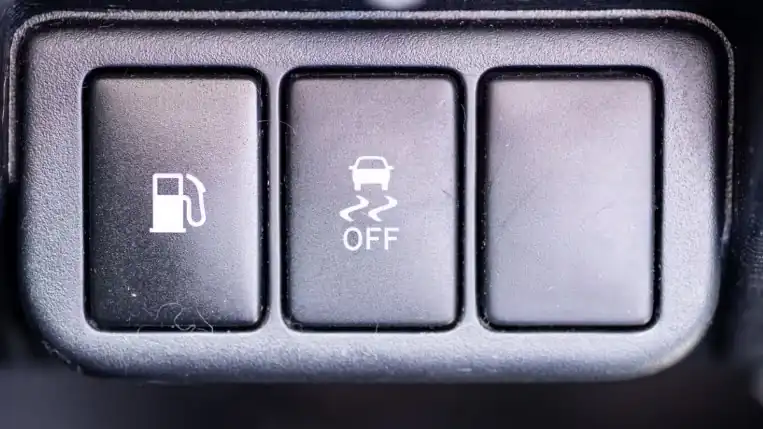
The simplest cause of a Service StabiliTrak warning is that the system was turned off manually. The StabiliTrak button is the same one used for the traction control system. It is usually located near the shifter, on the center console, or on the steering wheel, and shows an icon of a car with two squiggly lines behind it.
If the button was pressed, the light stays on. Press it again to turn the system back on and see whether the warning clears. This is the fastest way to reset the light when the cause is accidental.
Also consider the driving conditions. The light can appear temporarily on slippery roads when the system is actively working to keep the vehicle under control. If you were driving on snow, ice, mud, or heavy rain, the warning may disappear on its own once the surface is dry.
How to Reset Service StabiliTrak Light
If the button is not the cause, work through these reset methods from simplest to most involved.
Method 1: Restart the Vehicle
This gives the system a chance to run its self-check. If the light was caused by a momentary software glitch, a power cycle is often enough to clear it. If the message returns, move on to the next method.
Method 2: Disconnect the Battery
A disconnected battery clears stored faults in the control modules. This works for temporary glitches and after a low-battery event. Note that disconnecting the battery also resets other vehicle settings, such as the clock and radio presets.
Method 3: Cycle the Steering Wheel
This method targets the steering angle sensor, which tracks the position of the steering wheel. If the light turns off after cycling the wheel, the sensor was likely misaligned or needs recalibration.
Method 4: Use the StabiliTrak or ESC Button
Some GM models let you reset the system through the button itself:
On some models, holding the ESC button for six seconds or more turns the system off, confirmed by a buzzer. This is meant for situations where wheel spin is necessary, such as freeing a stuck vehicle. Turn the system back on for normal driving.
Method 5: Use an OBD-II Scanner
A scanner shows the actual fault behind the warning. For example, code C0121 usually points to a steering angle sensor fault, while codes in the C0035 range indicate a wheel speed sensor circuit problem. Clearing the codes resets the light, but the code returns if the fault is still present.
After the Reset: If the Light Comes Back On
A Service StabiliTrak light that returns after a reset means the system has detected an active fault. Common causes include:
None of these are fixed by a reset. Only replacing or repairing the failed component clears the warning permanently.
When the Reset Does Not Work
If the light stays on after every reset method, stop resetting and have the system diagnosed. StabiliTrak relies on accurate data from several interconnected components — the wheel speed sensors, steering angle sensor, ABS, and the electronic brake control module. A fault in any one of them can disable the entire system.
A qualified technician reads the trouble codes from the modules, inspects the sensors and wiring, and identifies the root cause before replacing parts. Because the reset does not repair mechanical or electrical faults, repeated resetting without a diagnosis will not resolve the issue.
Driving with StabiliTrak disabled is possible, but you lose the system’s help in low-traction conditions, on sharp turns, and during emergency maneuvers. Until the system is repaired, reduce speed, increase following distance, and avoid driving in rain, snow, or ice where possible.