
An Original Brand Manufacturer (OBM) is a company that designs, develops, manufactures, and sells products under its own brand name. An OBM owns the brand, the design, and the full product. It controls the intellectual property, the quality standards, and the way the product is marketed and sold.
This puts the company in direct control of the entire product, from the first idea to the product on the shelf. Its name is on the product, so it carries full responsibility for how that product performs and how customers perceive the brand.
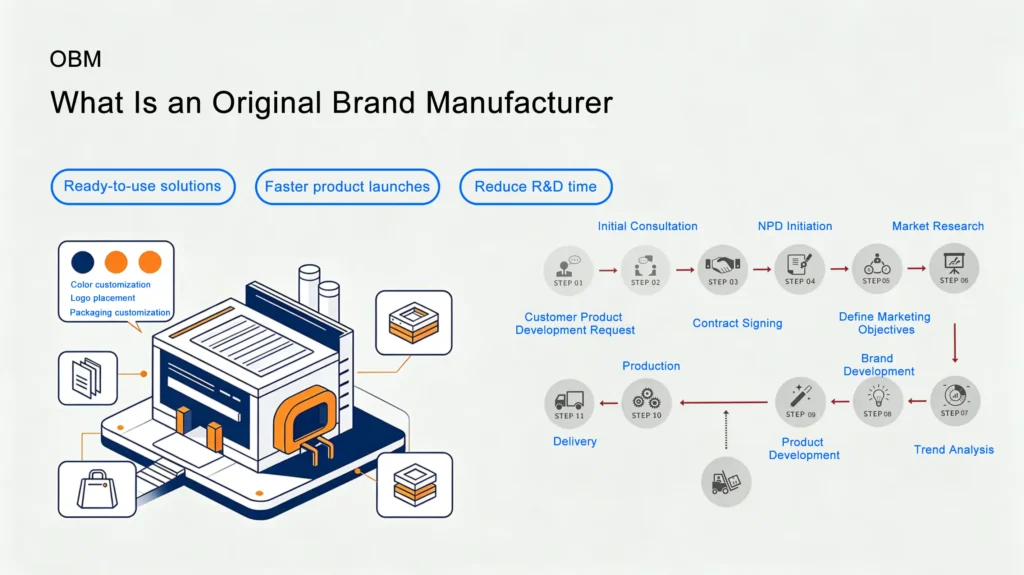
Advantages of the OBM
Brand ownership and control. An OBM owns its brand and its product identity. It decides the design, the features, and the quality standards, and it builds its own brand image and customer loyalty through its products.
Quality control. Because an OBM oversees the whole production process, it can hold products to strict quality standards and ensure they meet customer expectations. This builds a reputation for consistent, high-quality products.
Direct customer relationships.An OBM sells to its customers directly and can gather feedback, understand their needs, and shape products and services around them. Working directly with customers helps an OBM build satisfaction and lasting loyalty.
Pricing and profit.An OBM sells to its customers directly and can gather feedback, understand their needs, and shape products and services around them. Working directly with customers helps an OBM build satisfaction and lasting loyalty.
Innovation and flexibility.The company invests in research and development to create distinctive products and can adapt to market trends and customer preferences over time. It has the freedom to enter new markets, expand product lines, and shift its business a
Challenges of the OBM Model
High initial investment.Building a brand requires significant money and resources for product development, manufacturing, marketing, and technology. Creating a product from scratch involves heavy research and development, and launching a brand demands large marketing effort.
Intense competition. OBMs face fierce competition from other brands, private labels, and generic products. Standing out requires clear differentiation and constant innovation, which is hard to sustain in fast-moving markets.
Supply chain complexity. Managing production and supply chains brings risks around quality, delivery times, and cost. OBMs often rely on a network of suppliers, which adds complexity to quality control and logistics.
Brand responsibility. An OBM carries the full weight of its brand’s reputation. If a product fails in the market, it is the brand that suffers. This means the company must maintain high reliability, because a recall or a reputation problem is difficult and expensive to recover from.
Where OBMs Are Common
OBM is widely used in industries where brand identity and differentiation matter, including consumer electronics, fashion, automotive, and pharmaceuticals.
Well-known OBMs include **Apple**, **Samsung**, and **Sony** in consumer electronics; **Nike** and **Adidas** in apparel; **Tesla** and **BMW** in automotive; and **Coca-Cola**, **Procter & Gamble**, and **Nestlé** in consumer goods. These companies design, produce, and market their products under their own established brands, building direct relationships with customers.