XINGTAI YIWO AUTO PARTS CO., LTD.

English

What Does OEM Mean? How Original Equipment Manufacturing Works Across Industries

Jul 26, 2026 Leave a message

What Does OEM Mean?

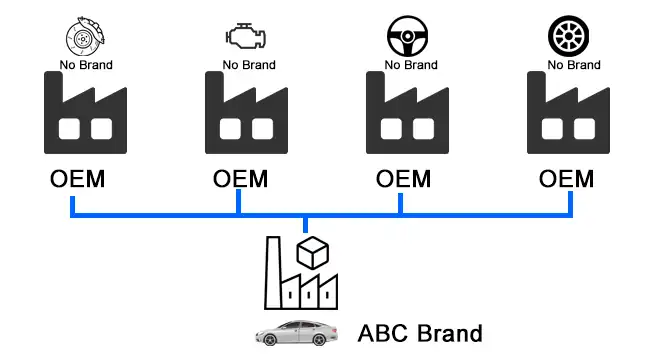
OEM stands for original equipment manufacturer. An OEM is a company that produces parts, components, or complete products that another company sells under its own brand name. The term appears across industries, from automotive and computers to industrial machinery.

The meaning has shifted over time. When the term first appeared during the industrial revolution, it described a company that built entire systems by bundling parts from various suppliers. Today, OEM more commonly refers to the company that manufactures the actual component. If Ford installs a Bosch fuel injector in a new vehicle, Bosch is the OEM. If Dell ships a laptop with an Intel processor inside, Intel is the OEM. The buyer sees the Ford or Dell logo on the finished product, but the critical parts inside come from specialized manufacturers.

Where the term comes from

The concept of the OEM took hold during the industrial revolution, when mass production made it impractical for one company to make every part in-house. Automakers began sourcing engines, batteries, and spark plugs from companies that could produce them more efficiently. By the mid-20th century, OEM partnerships were standard practice in automotive and aerospace. The model later spread to electronics, software, and virtually every other manufacturing sector.

What Does OEM Mean

How OEM works in different industries

If you are asking what does OEM mean in your specific field, the answer depends on the industry. The underlying idea is the same, but the details change.

Automotive parts

In the automotive world, OEM parts are the components installed during the original assembly of the vehicle. They are made by the vehicle manufacturer or by a supplier working to the manufacturer’s exact specifications. When a Toyota Camry leaves the factory, the brake pads, alternator, and timing belt inside it are all OEM parts.

Aftermarket parts are the alternative. These are made by third-party companies and sold as replacements after the vehicle is on the road. Aftermarket parts are often cheaper, but they may not match the original specifications exactly. For fleet operators and repair shops, knowing whether a part is OEM or aftermarket matters for warranty coverage and long-term reliability.

Computer hardware and software

The IT industry uses the OEM model just as heavily. When HP or Lenovo builds a laptop, they do not manufacture every component themselves. The processor comes from Intel or AMD. The hard drive comes from Seagate or Western Digital. The memory chips come from Samsung or Micron. These component makers are all OEMs.

Software works the same way. Microsoft sells OEM versions of Windows to PC manufacturers at volume pricing. The manufacturer installs the operating system on the machine before it reaches the customer. This bundling arrangement is one of the most visible examples of OEM partnerships in daily life.

Manufacturing and industrial equipment

In heavy industry, OEMs supply the specialized components that keep factories running. A machine tool builder might source spindle motors, control systems, and precision bearings from different OEMs, then assemble them into a finished lathe or milling machine. The same pattern applies to agricultural equipment, medical devices, and construction machinery. Each OEM focuses on a narrow category of parts, developing deep expertise that would be impossible for the final equipment builder to replicate in-house.

OEM vs. Aftermarket: what is the difference?

The line between OEM and aftermarket comes down to who made the part and when.

OEM parts are produced by the original manufacturer or its authorized supplier. They match the specifications of the parts that were in the product when it was first built. They typically cost more, but they fit precisely and often carry a manufacturer-backed warranty.

Aftermarket parts are made by independent third-party manufacturers. They are designed to replace OEM parts after the product has been sold. Aftermarket options are usually cheaper and more widely available. Quality ranges from excellent to poor. Some aftermarket parts match or exceed OEM standards. Others are built to a lower price point and may wear out faster or fit less precisely.

For buyers, the choice depends on the application. A safety-critical component like an airbag or brake caliper demands OEM precision. A cosmetic trim piece might work fine as an aftermarket alternative.

OEM vs. ODM: what is the difference?

ODM stands for original design manufacturer. The difference between OEM and ODM is who owns the design.

An OEM manufactures parts based on the client’s designs and specifications. The client retains the intellectual property. The OEM’s job is to produce exactly what the client has drawn.

An ODM provides both design and manufacturing. The ODM creates the product from its own proprietary designs, then the client brands it and sells it. Many consumer electronics, including smartphones and white-label laptops, are produced through ODM arrangements. The retailer gets a finished product with minimal design input. The ODM handles the engineering.

Why companies choose OEM partners

Companies partner with OEMs for practical reasons that show up on the balance sheet.

Cost reduction. OEMs operate at scale. They invest in specialized machinery, efficient processes, and bulk material purchasing that a single product company cannot match on its own.

Quality and reliability. An OEM that makes nothing but fuel injectors or memory chips develops deeper expertise than a generalist ever could. That specialization translates into tighter tolerances and more consistent output.

Faster time to market. Instead of spending years building manufacturing capability, a company can source components from an established OEM and focus its own resources on design and distribution.

Summary

OEM meaning is straightforward once you strip away the industry jargon. An original equipment manufacturer makes the parts that go into someone else’s finished product. Whether you are looking at a car, a laptop, or a CNC machine, the odds are high that several OEMs contributed components inside it. Understanding the difference between OEM and aftermarket parts, and between OEM and ODM partnerships, helps buyers make smarter decisions about quality, cost, and supply chain reliability.

References

  1. Wikipedia, “Original equipment manufacturer” 
    https://en.wikipedia.org/wiki/Original_equipment_manufacturer
Whatsapp