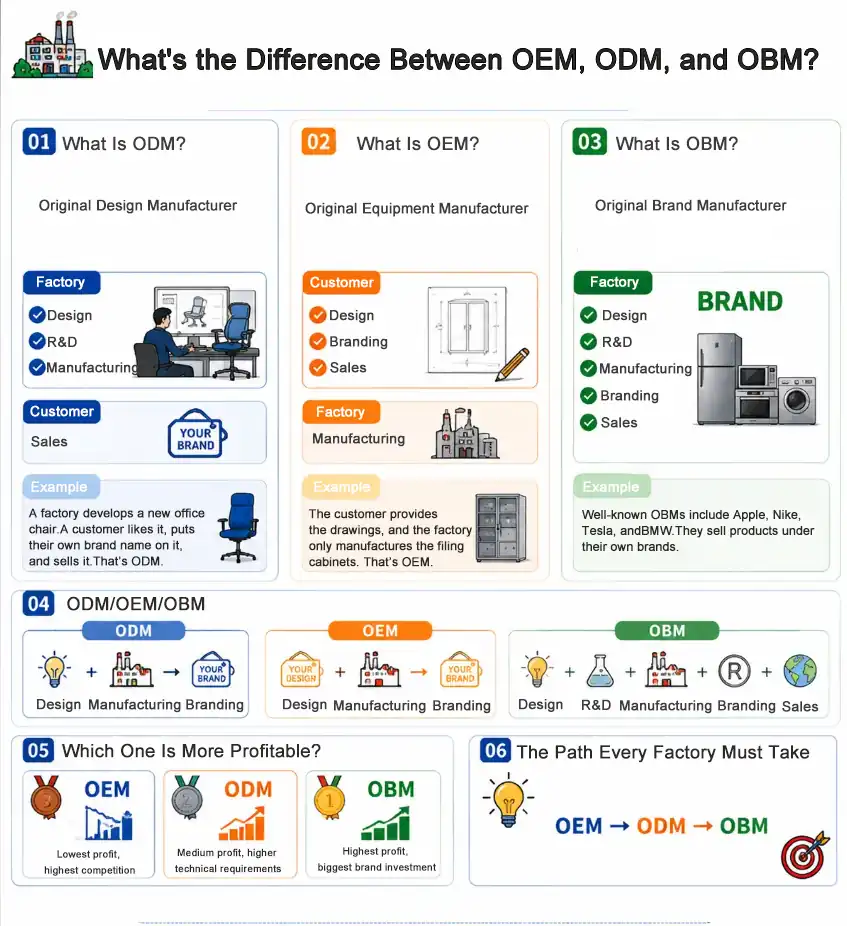
OEM, ODM, and OBM are three manufacturing models. The difference between them comes down to one question: **who owns the design, and who owns the brand.** Each model sits at a different point on that spectrum.
The Three Definitions
In this model, the buyer provides the design and the factory makes the product. The buyer owns the design and sells the finished product under its own brand. Put simply: you design it, we make it.
Here the factory designs and makes the product, and the buyer adds its brand. The factory owns the design; the buyer rebrands the product and sells it. Put simply: we design it, you brand it.
In this model, the company designs, makes, and sells the product under its own brand, controlling the entire process from concept to customer. Put simply: we design it, we make it, we sell it.
OEM vs ODM vs OBM: What’s the Difference?
| OEM | ODM | OBM | |
|---|---|---|---|
| Who owns the design | The buyer | The factory | The company itself |
| Who owns the brand | The buyer | The buyer | The company itself |
| Customization | High; made to the buyer’s spec | Standard design, small changes | Fully its own |
| Production | Factory builds to buyer’s design | Factory handles design and build | Own or outsourced |
| Customer relationship | The buyer’s customers | The buyer’s customers | Direct to consumers |
The Evolution: OEM to ODM to OBM
These three models also describe a company’s path up the manufacturing value chain. A company often starts as an OEM, making products for others at low margins. It then moves to ODM, adding its own design work for higher margins. Finally it reaches OBM, selling under its own brand for the highest margins and the most brand equity.
The value gain is clear. OEM contract work typically earns thin margins, while an OBM with its own brand can earn far more. The trade-off is risk: a contract manufacturer that loses an order loses revenue, while a brand that fails in the market suffers real damage to its reputation.
Pros and Cons
| Model | Pros | Cons |
|---|---|---|
| OEM | strong control over design and quality, protection of intellectual property, and flexibility to use multiple suppliers. | high research and development costs, slow lead times, and dependence on suppliers. |
| ODM | lower cost, fast time to market, and a low barrier to entry that suits startups. | limited differentiation, weak control over the design, and products that may be similar to competitors’. |
| OBM | the strongest brand, the highest profit margins, and direct customer loyalty. | heavy investment in research, production, and marketing, with high risk. |
Which One Should You Choose?
These models are not always a strict either-or. Many companies combine OEM and ODM for different products, and some grow from OEM into ODM and finally into a full OBM over time.